Spelling Bee Suffixes 2027: Find More Words With -ING, -ED, -ER and -LY
Suffixes turn one short word into three or four long ones. Here is how to use -ING, -ED, -ER and -LY to climb the ranks fast.
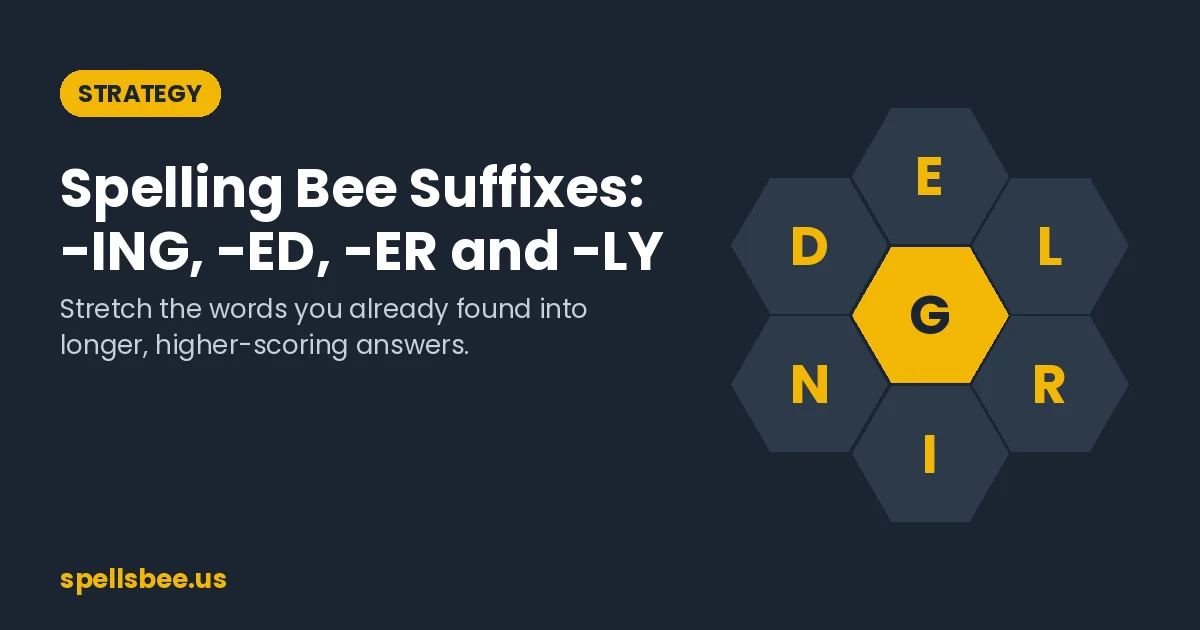
Check which suffix letters are in the hive. If you have I, N and G, add -ING to every verb you have found. With E and D, try -ED; with E and R, try -ER; with L and Y, try -LY. Spelling Bee has no S, so plurals never count, but most other common endings do.
Key takeaways
- Check which suffix letters the hive contains first
- -ING adds three letters and three points to any verb
- Drop the silent E and double short-vowel consonants
- No S means no plurals, -NESS or -EST
On this page
- Why suffixes are the easiest points in the hive
- Suffix checklist: what the hive needs
- -ING: the most valuable suffix
- -ED and -ER: two endings from one pair of letters
- -LY and -Y: turning nouns and adjectives
- Longer suffixes that often hide the pangram
- Prefixes work the same way
- A 3-minute suffix routine
- FAQ
Most Spelling Bee players find the short, obvious words first and then stall. The fastest way to break through is to stop looking for brand-new words and start stretching the ones you already have. Suffixes such as -ING, -ED, -ER and -LY turn one word into three or four, and every extra letter adds a point. This guide shows which suffixes each hive allows, which ones the game accepts, and a simple routine to find them.
Why suffixes are the easiest points in the hive
In Spelling Bee a 4-letter word is worth 1 point, and every longer word scores 1 point per letter. That means adding -ING to a 4-letter verb turns a 1-point word into a 7-point word. Suffix words are also the ones players skip most, because once you have found PLAN you rarely think to go back for PLANNED, PLANNER and PLANNING.
See Spelling Bee ranks for how those points move you towards Genius.
Suffix checklist: what the hive needs
| Suffix | Letters needed | Works on | Example |
|---|---|---|---|
| -ING | I, N, G | Verbs | LOAD → LOADING |
| -ED | E, D | Verbs | PLANT → PLANTED |
| -ER | E, R | Verbs, adjectives | TEACH → TEACHER, TALL → TALLER |
| -EST | E, T (plus S, so never) | Adjectives | Not possible: no S in the game |
| -LY | L, Y | Adjectives | NEAT → NEATLY |
| -FUL | F, U, L | Nouns | HELP → HELPFUL |
| -TION | T, I, O, N | Verb stems | NOTE → NOTATION |
| -ABLE | A, B, L, E | Verbs | READ → READABLE |
| -Y | Y | Nouns | DIRT → DIRTY |
Because Spelling Bee never uses the letter S, endings like -S, -ES, -NESS and -EST are always out. That is why the suffixes above matter so much.
-ING: the most valuable suffix
When a hive contains I, N and G, it is almost always a big puzzle. Go through every verb you have found and try -ING on each one. Remember the spelling changes:
- Drop the silent E: BAKE → BAKING, RIDE → RIDING.
- Double the last consonant after a short vowel: PLAN → PLANNING, GRIN → GRINNING.
- Keep the word as it is for most other verbs: LOAD → LOADING, PAINT → PAINTING.
Also look for -ING nouns that are words on their own: CEILING, LINING, TIDING.
-ED and -ER: two endings from one pair of letters
E is in a huge share of hives, so -ED and -ER come up constantly. If you have E, D and R together, test all three forms for each verb: PAINT, PAINTED, PAINTER. Doubling rules apply here too: TRIP → TRIPPED, TRIPPER. Watch out for words where -ER makes a different word altogether, such as DIN → DINNER.
-LY and -Y: turning nouns and adjectives
With L and Y in the hive, every adjective is a chance for an adverb: NEAT → NEATLY, ODD → ODDLY. With just Y, test nouns that become adjectives: DIRT → DIRTY, LUCK → LUCKY, TRICK → TRICKY. Y also forms many pangrams because it joins so many words.
Longer suffixes that often hide the pangram
The pangram uses all seven letters, so it is usually a long word, and long words very often end in a suffix. If you are stuck on the pangram, look at which suffixes the hive can build, then work backwards:
- -TION: hives with T, I, O and N often hide words like NOTATION or ADDITION.
- -ABLE / -IBLE: try them on verbs you have found: READABLE, EDIBLE.
- -MENT: needs M, E, N, T: PAYMENT, MOMENT.
Our pangram checklist has more ways to spot it.
Prefixes work the same way
Suffixes are not the only add-on. Prefixes such as RE-, UN-, DE- and PRE- stretch words from the front: READ → REREAD, TIE → UNTIE, CODE → DECODE. Do one pass for suffixes and one pass for prefixes, and you will catch most of the words you missed.
A 3-minute suffix routine
- List the suffixes the hive allows (look at I-N-G, E-D, E-R, L-Y, Y).
- Read your found words from top to bottom and add each suffix to every word it fits.
- Apply the spelling rules: drop silent E, double short-vowel consonants.
- Check prefixes RE-, UN- and DE- on the same list.
- Look for the pangram among the longest new words.
Practise the routine on a fresh hive in Spelling Bee Unlimited, or use the hint grid to see how many long words you still need.
Frequently asked questions
Do plurals count in Spelling Bee?
No. The game never includes the letter S, so plural forms ending in S or ES cannot be made.
Does Spelling Bee accept -ING and -ED words?
Yes. Common inflected forms such as PLANTED and PLANTING are accepted, as long as they use the centre letter and only letters from the hive.
What is the best suffix to look for first?
-ING, because it adds three letters and three points to any verb. If the hive does not have I, N and G, move to -ED and -ER.
Can I reuse letters to make a suffix?
Yes. Letters can be used as many times as you like, so PLANNING uses N three times and still counts.